FEW YEARS AGO

Sunday, March 31, 2013

‘Eyes of Hate’ Captured in Portrait of Nazi Politician by Jewish Photographer


In September 1933, LIFE magazine photographer Alfred Eisenstaedt traveled to Geneva to document a meeting of the League of Nations. One of the political figures at the gathering was Nazi propaganda minister Joseph Goebbels, one of Hitlers most devout underlings and a man who became known for his “homicidal anti-Semitism.”
Eisenstaedt was a German-born Jew. Not knowing this at first, Goebbels was initially friendly toward Eisenstaedt, who was able to capture a number of photos showing the Nazi politician in a good and cheerful mood (as in the photograph above).

However, Goebbels soon learned of the Jewish blood flowing through Eisenstaedt’s veins. Subsequently, when Eisenstaedt approached Goebbels for a candid portrait, the politician’s expression was very, very different. Instead of smiling, he scowled for the camera, and the famous photo that resulted shows the man wearing “eyes of hate”:
Eyes of Hate Captured in Portrait of Nazi Politician by Jewish Photographer goebbals scowling
Here’s what Eisenstaedt later shared regarding experience:
I found him sitting alone at a folding table on the lawn of the hotel. I photographed him from a distance without him being aware of it. As documentary reportage, the picture may have some value: it suggests his aloofness. Later I found him at the same table surrounded by aides and bodyguards. Goebbels seemed so small, while his bodyguards were huge. I walked up close and photographed Goebbels. It was horrible. He looked up at me with an expression full of hate. The result, however, was a much stronger photograph. There is no substitute for close personal contact and involvement with a subject, no matter how unpleasant it may be. [#]
…and:
He looked at me with hateful eyes and waited for me to wither. But I didn’t wither. If I have a camera in my hand, I don’t know fear. [#]
This powerful photograph would become one of Eisenstaedt’s most famous images, though he did shoot an even more iconic just months after Goebbels committed suicide at the end of World War II.
On August 14, 1945, Eisenstaedt photograph a sailor celebrating Japan’s surrender by kissing a random nurse in New York City. The photo came to be known as “V-J Day in Times Square.”
(via Iconic Photos and Erik Kim)

P.S. This photograph reminds us of Yousuf Karsh’s famous portrait of Winston Churchill, in which Karsh elicited a scowl from Churchill by stealing the cigar that was in Churchill’s mouth.


6 comments:


  • September 1933, Germany was in the middle of an unprovoked international Jewish boycott of German goods, because Jews did not like the democratic will of the German people who elected Adolf Hitler. Everywhere that Jews exercised great wealth and power, such as Paris, New York ,etc, sales of German goods were forbidden or suffered dearly. There was a counter-boycott by the Germans of Jewish businesses, that is iconic and constantly referred to as racist, but never is the actual context provided. The more you know-..
  • Avatar
    WillToPower  an hour ago
    Goebbels looks more angry at the fact that there is a jew continuously photographing him, while he's busy with the man to his right. "Eyes of hate", ever read what the Talmud says about gentiles?
    • Avatar
      Brendan Tonkin  5 hours ago
      Thanks for posting both of these articles Michael. I love that both of these figures are in their own ways the most terrifying people to photograph, but to get these shots the photographer had to impose themselves into the scene - even if the photo itself doesn't show there part of the story.
      I'm sure that this is the key to brilliant portrait photographers, but it's hard to imagine other examples where you would need that much guts to do it.
      • Avatar
        Christian Bartsch  6 hours ago
        scary how ideologies poison souls - but great to see photographs are able to show it..
        • Avatar
          Evropa  34 minutes ago
          You forgot the 'trademark' symbol after the word 'hate'.


        Saturday, March 23, 2013

        Digital Negative App Lets You Shoot RAW Photos with Your iPhone Read more at http://www.petapixel.com/2013/03/22/digital-negative-app-lets-you-shoot-raw-photos-with-your-iphone/#P3f2iLxqZAcE0rJt.99


        Digital Negative App Lets You Shoot RAW Photos with Your iPhone iph4 screenshot4 copy
        About a year ago, we shared an app called 645 Pro that saves photos shot with the iPhone (and other iOS devices) as TIFF files. Now there’s a new app that’s even more “raw”. Digital Negative, a new app by a company called Cypress Innovations, claims to be the first app that captures uncompressed images that retain 100% of the information captured by the camera sensor.

        Digital Negative App Lets You Shoot RAW Photos with Your iPhone iph4 screenshot1 copy
        The app works on the iPhone, iPad, and the iPod Touch, and stores DNG (Digital Negative) files, just like the RAW DNG files produced by cameras that have signed onto the DNG standard.
        Digital Negative App Lets You Shoot RAW Photos with Your iPhone iph4 screenshot2 copy
        This means you’ll be able to pop the files into your favorite RAW processing program (e.g. Adobe Camera RAW, Lightroom, Aperture) and post-process them there.
        The app has preview tools built in for on the go reviewing, and also features a built-in RAW developer for if you’d like to produce JPEGs on the go. You can also set it to capture TIFF or JPEG images for times when you don’t need to store RAW files.
        Digital Negative App Lets You Shoot RAW Photos with Your iPhone iph4 screenshot3 copy
        When capturing a photo using the app, it’ll show you a real-time histogram to help you avoid under- or over-exposing your photos. Other camera features include exposure locking, flash control, focus control, and zoom controls.
        Digital Negative App Lets You Shoot RAW Photos with Your iPhone iph4 screenshot5 copy
        Once photos are captured, DNG files can be stored on Dropbox, or JPEG images can be shared on Facebook.
        Digital Negative App Lets You Shoot RAW Photos with Your iPhone iph5 screenshot1 copy
        The app is available for $3 over in the iTunes App Store. Reviews are mixed so far, so even though the idea is interesting: caveat emptor.
        Digital Negative [App Store via The Phoblographer]

        Monday, March 18, 2013

        More Americans take Israel's side over Palestinians' as Obama heads to Middle East


        New data shows that 55 percent of Americans sympathize with Israel over Palestine, while only 9 percent side with Palestine. But despite the stark preference for the Jewish nation, 70 percent of Americans wish the US would stay out of the conflict.
        Thirty-six percent of respondents in the ABC News / Washington Post poll said they were undecided or favored neither country. But of those who picked a side, 86 percent chose Israel over Palestine, confirming the stark preference that has existed since similar questions were first asked in the 1980s.
        But despite 64 percent of respondents siding with a country, two-thirds said they do not want the US to have a leading role in the conflict. And of those who had no preference, 70 percent said the US should stay uninvolved. 

        U.S. Military Aid and the Israel/Palestine Conflict

        A second poll, published on Friday by Gallup, is consistent with the findings of the one conducted for ABC News. Gallup found that 64 percent of Americans sympathize for Israel, which is up from the 60 percent who said so in 2010 and is “the highest-recorded in a quarter century”. Only 12 percent of respondents said they sympathized more with Palestine.
        And Israeli sympathy has been on the rise: since Gallup first asked the question in 1988, there has been a steady increase in preference for Israel and a steady decrease in those who had no opinion or favored neither side.
        US Financial Aid To Israel -  Figures, Facts And Impact

        The results come as US President Barack Obama prepares for his visit to Israel, Palestine and Jordan on Wednesday.
        But despite Americans’ preference for the Jewish state, the feelings are one-sided. Israeli sympathy for Americans has gradually declined. Many blame President Obama for failing to keep up the relationship with Israel. For example the president did not sit down with an Israeli journalist until July 2010.
        In 2009, the Jerusalem Post reported that only 4 percent of Israeli Jews viewed Obama as more pro-Israel, while 51 percent believed he was pro-Palestinian. Jennifer Rubin of the Washington Post says that Israelis are surprised that such a pro-Israel country elected a president who “they see as hostile to them”.
        But as Obama visits Palestine and Israel this week, most Americans hope for him to stay out of the conflict.
        “When it comes to US involvement in the peace process, there’s agreement across religious, partisan and ideological groups (from 66 to 70 percent) that the two sides should handle negotiations themselves,”the ABC report states.
        Anti-AIPAC Activists See An Opportunity in Sequestration No Head Start, No Iron Dome...CLEAR?!!

        Saturday, March 16, 2013

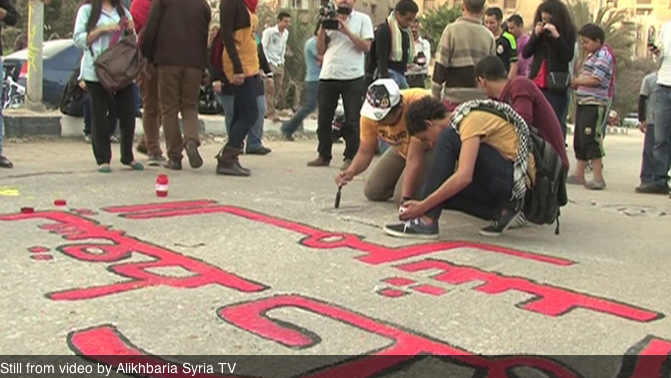
        RT cameraman beaten as Morsi supporters attack protesters (VIDEO)


        A cameraman working for RT's Arabic channel in Egypt has been attacked while filming activists drawing graffiti near the Muslim Brotherhood’s headquarters in Cairo. The incident comes amid on-going protests against President Morsi.
        RT’s Mukhtar Ahmed was beaten and suffered a head injury while he was trying to protect his camera as a gang of men armed with sticks and knifes attacked a group of activists and journalists who were covering the event near the Muslim Brotherhood’s headquarters.
        The injured crewmember was immediately rushed to the nearest hospital where he needed stitches. A number of other journalists were reportedly beaten and assaulted.
        RT’s camera was broken and stolen, so the video has been provided by the Syrian Al-ikhbaria news channel.
        The attackers may have been Islamic supporters of the Muslim Brotherhood, they assaulted both those drawing anti-government slogans and journalist covering the event, RT’s crew said. Journalists were invited to cover the event organized by a small group of activists against, as they called him, the “puppet dictator Mohamed Morsi.”
        Egypt is in an endless state of unrest with anti-government protests being staged across the whole country. Such events often end with clashes between supporters and opponents of the Islamist president.

        Still from video by Alikhbaria Syria TV
        Tear gas shot at Morsi protesters
        Earlier on Saturday, a number of people were injured and suffered intoxication as police fired teargas at Morsi protesters in the city of Sohag.
        Thousands took to the streets around Thaqafa Square in Sohag, protesting against Morsi and his Muslim Brotherhood party, accusing them of monopolizing the power and breaking their promises for democratic reforms.
        Police had to use force including teargas to quell the angry crowd.
        Earlier in the day, protesters had attempted to storm the assembly where Morsi was holding a meeting with the officials.  Supporters of the president intervened to stop the crowd that gathered on Akhmim Bridge across from Sohag's administrative governorate building. Police used teargas there as well.
        The Egyptian leader was forced to cancel his attendance at the local university as hundreds of students gathered there chanting, "President Morsi, we do not want you."
        The official visit of the leader and Prime Minister Hisham Qandil to Sohag is part of the overall development plan for Upper Egypt and as part of the National Housing Project, which includes construction of 1,272 new housing units in Sohag, one of Egypt’s poorest southern cities.
        “Sohag is the heart of al-Saeed, which cannot be dismembered from Egypt or Egyptians,” Morsi said.
        “We have received all of your requests and suggestions that you put forth and we will look into them,” he said, adding that housing, jobs, roads and security will be reviewed by the government.
        His speech was strongly supported by his followers, who chanted that they were willing to put their lives on the line in support of the president and Muslim Brotherhood.


        Tuesday, March 5, 2013

        Choros: A Hypnotic Short Film Featuring Single Dancer with 32 “Visual Echoes”


        Choros: A Hypnotic Short Film Featuring Single Dancer with 32 Visual Echoes choros 1

        Choros: A Hypnotic Short Film Featuring Single Dancer with 32 Visual Echoes choros 2


        Choros: A Hypnotic Short Film Featuring Single Dancer with 32 Visual Echoes choros 3“Choros” is a beautiful experimental film by Michael Langan and dancer Terah Maher. It features a single dancer layered 32 times, which each layer slightly offset in time from the previous one. The “visual echo” technique turns a single woman into a “chorus of women,” and transform the dance from single movements into waves of motion. The 13-minute video is set to the songMusic for 18 Musicians by Steve Reich.


        Langan is building on the work of famous pioneers in the history of photography, including Eadweard Muybridge and Etienne-Jules Mare. The technique is a variation of what’s known aschronophotography, which captures movement in numerous frames.
        In the late nineteenth century, a photographic technique called “chronophotography” began to develop, whereby multiple photographs would be taken in rapid succession to study the movement of a given subject. Eadweard Muybridge famously filmed a horse in motion in 1878, providing the world with its first taste of motion pictures when the images were displayed on a spinning zoetrope.
        Several years later, the French physicist Etienne-Jules Marey developed a stunning variation of this technique when he captured multiple poses of a subject over time onto a single frame of film, rendering a kind of visual echo. The nature of this process limited the subject matter to that which could be photographed in a black studio using stark lighting, to prevent overexposure of the background when multiple images are layered over one another.
        [...] “Choros” revisits these technical innovations and attempts to contribute original innovations of its own. Using recent advancements in digital compositing, the technique developed for “Choros” introduces color, frees the film from the confines of a black studio, and allows the dancer to linger in one position without risk of overexposure, resulting in a variation of this historical technique that allows a degree of subtlety heretofore prohibited by technical limitations. [#]
        You can learn more about this film on its dedicated webpage.

        Tuesday, February 26, 2013

        Fashion Mag Uses Photos of White Model to Illustrate ‘African Queen’ Editorial


        Make me Happy?

        International fashion magazine Numero is raising some eyebrows with its choice of photography for an editorial titled, “African Queen.” The piece features 16-year-old Ondria Hardin — a caucasian model — with heavily darkened skin.

        Foudre calls Hardin’s appearance blackfacebody, and writes, “why hire a black model when you could just paint a white one!”
        Here are a selection of the photographs found in the piece:
        Fashion Mag Uses Photos of White Model to Illustrate African Queen Editorial africanqueen
        Fashion Mag Uses Photos of White Model to Illustrate African Queen Editorial africanqueen2
        Laura Beck over at Jezebel writes,
        It’s impossible to look at this and not ache for young women of color who want to pursue careers in modeling (and arguably, fashion by extension). When they don’t see themselves on the runway or in magazines, it could be very easy for them to think, “huh, I guess modeling isn’t for me.” Then the status quo reigns, and the runways remain monotone. If jobs for “African Queen” photo spreads aren’t going to black women, what hope is there?
        Julee Wilson of the Huffington Post offers a similar criticism:
        [...] the editorial serves as another sad example of how the fashion industry continually ignores or exploits ethnic diversity rather than celebrating it. And to think how easy it would have been for Numéro to select one of the countless beautiful black models and avoid this justifiable backlash and contribution to an unrelenting problem.
        Beck also did some digging, and found that Hardin’s modeling agency has a number of black models on its roster that could possibly have been used for this shoot.

        Thanks for the tip, Sam!